
A portion of the property on which UMBC is built previously was owned by the Baltimore Manual Labor School. Also known as the Farm School, it operated from 1839 to 1922 with the purpose of instructing and supporting poor or orphaned boys from Baltimore City. Support for the school came…Read More

In addition to moral and religious teachings, the Baltimore Manual Labor School resident boys were taught how to read and were instructed in agriculture or other useful occupations in preparation to earn a living. Under staff supervision they tended the orchards and vegetables grown on the farm.Baltimore Manual Labor School…Read More

Edmund Stabler (1847-1905) became superintendent of the Baltimore Manual Labor School in 1884, and upon his retirement in 1904 the board of the school gave Stabler 13 acres of land along Walker Avenue, including the home in which he, his wife, and their six children had been living. Albin Kuhn…Read More

Dressed for the occasion of the photograph, some of the young men who lived and worked at the Baltimore Manual Labor School posed on the porch of a school building. Baltimore Manual Labor School Collection, gelatin silver prints; black-and-white photographs, 8 x 10.

During the 1940s into the 1950s, dramatic increases in the number of Marylanders seeking a university education motivated State officials to begin planning for expansion of the University of Maryland. Beginning in 1955, a series of state commissions studied the need for expanding publicly supported higher education. Each recognized that…Read More

Several bills were introduced into the Maryland Senate and the House of Delegates in the 1950s and early 1960s, and each approached the need for changes to public higher education from a different direction. Passage of the legislation in 1963 allowed the University of Maryland Board of Regents to begin…Read More

The Warfield Commission, appointed by the governor in 1959, issued its report in February 1960. Titled A Plan for Expanding the University of Maryland, the report suggested expansion of UM by bringing Towson, Frostburg and Salisbury Universities under the UM administration and creating regional campuses in various areas of the…Read More

Albin O. Kuhn papers, Collection 44, resolutions (administrative records), 11.7 x 8.9.

Albin O. Kuhn papers, Collection 44, resolutions (administrative records), 11.7 x 8.9.

Albin O. Kuhn papers, Collection 44, bills (legislative records), 12 x 9.

During the 1940s into the 1950s, dramatic increases in the number of Marylanders seeking a university education motivated State officials to begin planning for expansion of the University of Maryland. Beginning in 1955, a series of state commissions studied the need for expanding publicly supported higher education. Each recognized that…Read More

During the early planning stages for the expansion of the University of Maryland, one possible location for the new campus was the Inner Harbor of Baltimore City. Consideration of the site went as far as making a Diagrammatic Scheme as a “Proposal for Downtown Campus for University of Maryland Implementation…Read More

After a long process, with many different opinions expressed, the Board of Regents finally approved plans to build a University of Maryland branch on a 425 acre tract of mostly State-owned land near Catonsville in Baltimore County. An article in The Evening Sun newspaper announced the selection of Catonsville for…Read More

Reasons for selecting the Catonsville site included: the site was adjacent to I-695 and not too far from College Park; it was large enough to allow for future development of the campus; the state already owned most of the land. The photograph shows a view from Hilltop Building looking toward…Read More

News of the selection of the Catonsville site for a new UM campus was covered by the Baltimore dailies as well as the local County newspapers. The Times, headquartered on Sulfur Spring Road in Arbutus, naturally covered more detail about the site and the rationale for the location of the…Read More

Once the Catonsville site was selected for the expansion of the University of Maryland, Dr. Kuhn quickly began working on specifications for the new campus. He visited universities across the country to get ideas for the construction of both buildings and academic programs, and on airline flights home he wrote…Read More

Senate Bill No. 73, introduced by Senator James Pine, a Democrat from Baltimore County, specifically mentioned having a UM branch in Baltimore County. Albin O. Kuhn papers, Collection 44, bills (legislative records), 8.5 x 11.

While flying home from New Orleans, Dr. Kuhn noted “more classrooms” and “Block programs to keep st[udents] in certain areas of campus.” Further down the page, he wrote: “move prof[essors] to students,” and “Place classrooms on lower floors.” He was ruminating about the most efficient way for students to attend…Read More

Making the new campus one devoted to research was on Kuhn’s mind as he began thinking about a campus “Master Plan.” “Extensiveness of Research—Kinds of research…and Balance of Govt. sup[port] vs commercial [support]” and “Short term vs long term research.” He also wondered: “Shall DORM AND D.H. [dining hall] be…Read More

Aerial photographs of campus have been made periodically throughout UMBC’s history. This 1969 view shows various ongoing construction projects, including the first dormitories (slightly above and left of center), the Physical Plant building (now the Public Safety Building) along Hilltop Circle (then called “The Loop,” which was only half finished),…Read More

Not all of the land on which the new campus was going to be built was already owned by the state. One parcel was owned by the Stabler Family, 13 acres along Walker Avenue approximately where the Library & Gallery is now situated. The State acquired the land in 1965…Read More

Dr. Kuhn’s brainstorming took physical shape in 1965 when he hired Guy Chisholm from UM College Park to serve as the director of the physical plant and supervise the construction of UMBC. A native Texan, Chisholm had earned a degree in landscape architecture and later became a partner in a…Read More

John D. Haskell was the first full time UMBC employee. He was responsible for starting the Library, although Haskell’s initial days at the university were spent not at UMBC but at College Park where he was oriented “into the policies and procedures of the University of Maryland libraries system.” It…Read More

Published on the opening day of UMBC, September 19, 1966, was the first issue of UMBC News which carried the bold headline “DR. KUHN GREETS STUDENTS.” Dr. Kuhn was very student oriented, and declared in the front page article: “We welcome the new students, for a campus does not come…Read More

Aerial photographs of campus have been made periodically throughout UMBC’s history. This 1969 view shows various ongoing construction projects, including the first dormitories (slightly above and left of center), the Physical Plant building (now the Public Safety Building) along Hilltop Circle (then called “The Loop,” which was only half finished),…Read More

The first Spring Week (an early version of Quadmania) took place April 22- 29, 1967, and began with a rousing Saturday evening performance by the “King of Soul,” Otis Redding (1941-1967). The performance was for a semi-formal dance in Gym 1 and was also broadcast into the Commuter Cafeteria for…Read More
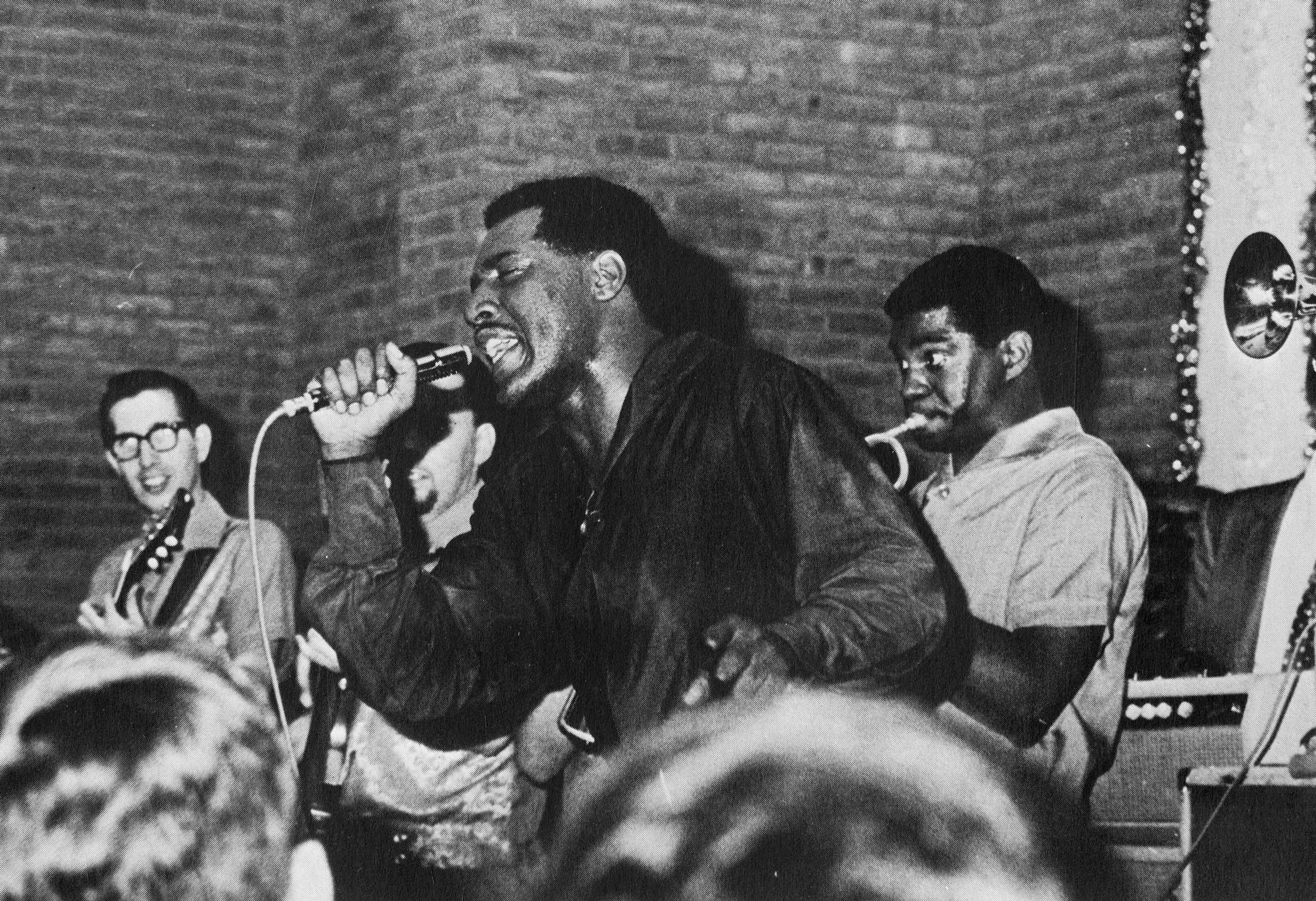
University Publications, school yearbooks; black-and-white photographs.

The first decade of UMBC’s operation saw periodic campus discomforts caused by controversial subjects, and nude photographs published in the fall 1968 issue of Dialogue, the UMBC literary magazine, was one such occasion. Ten photographs of nude dancers by Washington, D.C. photographer M.E. Nage (a.k.a. photographer Ron Stark) were published…Read More

To the founding students and pioneers, UMBC must have seemed a large construction site. This photograph of the Administration Building under construction is viewed looking down what is now known as Academic Row. University Photographs, gelatin silver prints; black-and-white photographs, 3.5 x 5.

Complaints began soon after publication. Chancellor Kuhn issued a statement responding to the photographs, explaining that “as is the practice in all universities, there is no prepublication censorship” at UMBC. He observed that “the pictures do not relate to the articles and are presented without comment or interpretation… The pictures…Read More

These photographs, taken by a student photographer for The Retriever, are from a 14-6 win for the men’s lacrosse team against the Loyola Greyhounds “B” team, April 1, 1969.University Photographs, UARC Photos 07, F older 38, Sheet 7, UARC Photos-07-01-1744-1777, black-and-white photographs; contact sheets, 8 x 10.

In response to a 1969 University of Maryland report on integration, Dr. Kuhn appointed a committee chaired by English professor Philip J. Klukoff to draft a report making specific recommendations for UMBC to attract more minority students. The report states that UMBC “must demonstrate active concern for the causes and…Read More

Campus unrest continued to stimulate the expression of diverse views and airing of grievances not only in person, but also in print. The Red Bricks and The Red Brick were published by student leaders to protest a range of concerns, from the lack of student government influence in campus affairs…Read More

Once UMBC was open and operating, the firms of RTKL, Inc. (Architects and Planners), Rummel, Klepper, and Kahl (Site Engineers), and Egli and Gompf, Inc. (Mechanical and Electrical engineers) were asked to create a Master Plan for use as a record of the campus development and as a tool for…Read More

National concern for student demonstrations in the 1960s and 1970s prompted Congress to pass laws that would penalize students who accepted federal scholarship or loan money and got arrested for civil disobedience. Selected sections of Public Law 90-557 that describe the circumstances of possible arrests and penalties were compiled and…Read More
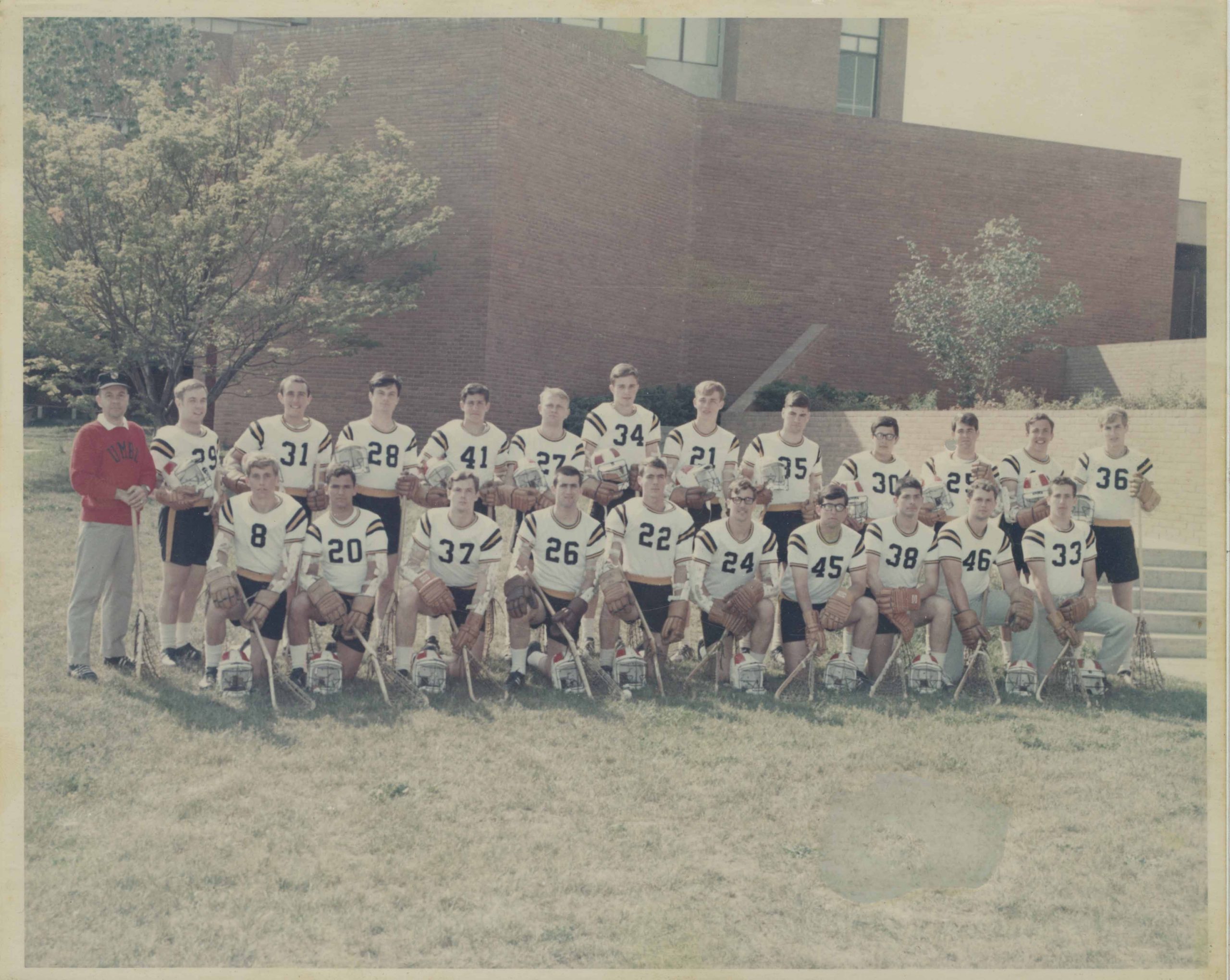
Lead by Jeff Hahn who scored 32 goals that season, the most among all lacrosse players in the state that year, the 1969 UMBC men’s lacrosse team was victorious against rivals Loyola University of Maryland and Western Maryland College. Outstanding performances were contributed by Dave Mister and Tom Pilsch. Hahn…Read More

Aerial photographs of campus have been made periodically throughout UMBC’s history. This 1969 view shows various ongoing construction projects, including the first dormitories (slightly above and left of center), the Physical Plant building (now the Public Safety Building) along Hilltop Circle (then called “The Loop,” which was only half finished),…Read More

Campus unrest continued to stimulate the expression of diverse views and airing of grievances not only in person, but also in print. The Red Bricks and The Red Brick were published by student leaders to protest a range of concerns, from the lack of student government influence in campus affairs…Read More

Norman V.A. Reeves, Counselor, and Howard Rawlings, Instructor of Mathematics, co-chairs of the UMBC Caucus of Black Faculty and Staff, were in contact with Dr. Kuhn about ways to further diversify UMBC. The goal of the Caucus was “the creation of a truly egalitarian university.” Reeves later served on the…Read More

Dr. Kuhn wrote a ten-page response to the February 10, 1970 letter from the UMBC Caucus of Black Faculty and Staff, setting out his views and offering advice for pursuing solutions to the problems outlined by Reeves and Rawlings. “Your discussions and your statement… refer to appropriate representation of blacks…Read More