
The New Democratic Coalition, a regional political group, sponsored environmental awareness activities during April and May 1970. Speakers included Biological Sciences Department professors Robert Burchard and Bob Platt. On Earth Day, Students demonstrated in front of Hillcrest Building and aired their concerns. The Retriever published a schedule of events that…Read More

Students decorating Gym I for a dance. University Photographs, gelatin silver prints; black-and-white photographs, 8 x 10.

On Thursday, May 7, 1970, students and faculty came together and took part in picket lines and teach-ins, and made speeches expressing their concerns. They called for a campuswide strike on May 8, counter to Kuhn’s announced resumption of classes. The rally ended with a march to the Catonsville Selective…Read More

Mass demonstrations erupted at many U.S. campuses following the shootings at Kent State University on May 4, 1970. In response, the UMBC Assembly passed a resolution declaring Thursday, May 7th a day of mourning and reflection and established a committee to plan observances for the campus. President’s office records, Collection…Read More

Dr. Kuhn’s memorandum assured students that classes would be held on Friday, May 8, 1970 and students could choose to attend or not. “If the University were to suspend the right of students to attend classes or the right of faculty to teach, it would be setting aside the most…Read More

Dr. Kuhn’s memorandum assured students that classes would be held on Friday, May 8, 1970 and students could choose to attend or not. “If the University were to suspend the right of students to attend classes or the right of faculty to teach, it would be setting aside the most…Read More

Correspondence, 11 x 8.5.

Memo from Homer Schamp, Jr., Vice Chancellor for Academic Affairs, to All Faculty assuring faculty members that their right to conduct classes would be protected and warning that “students who attempt disruption of classes or examinations should be made aware that they are subjecting themselves to possible suspension or other…Read More

UMBC’s first graduation ceremonies occurred on June 7, 1970. Diane Juknelis, a student receiving a B.A. in political science, spoke about the new campus “making its mark” as a “new, innovative, young, and strong” school. “The present class of graduates is the first in a long line of innovators who…Read More

Albin Owings Kuhn (1916-2010) was UMBC’s first president (then called chancellor). He began his career in higher education at the University of Maryland, College Park; after completing his bachelor’s, master’s, and doctoral degrees there, he served as a professor of agronomy and chair of the Agronomy Department. In 1965 when…Read More

A UMBC Senate passed resolution during the 1970-1971 academic year stated: “That the discipline of Afro-American Studies be establish[ed] by September 1971.” Mazi Dr. E.N. Njaka was hired as coordinator of the program, with the same status as a department chair, and a panel of experts including Dr. S.N. Nwabara…Read More

Members of the Black Caucus of Faculty and Staff pursued their concerns to the State of Maryland Commission on Human Relations, which issued a report that stated: “The statistical data presented to the Commission at the time this investigation was initiated, combined with additional statistical data gathered during the investigation,…Read More

The first SGA meeting of the 1971-72 academic year occurred during the first week of classes, and was covered by the Retriever Weekly with photography by William Morganstern. Pictured left to right are David Rowe, newly elected People’s Party candidate for SGA president; Carl Wheeler, SGA senator; and Tony Hunstiger,…Read More

Places where students could socialize were limited during the early years of the campus. One popular location in 1971 was the Rathskeller, which was located in the basement of Hillcrest Building. The Ratt was a popular location that served alcohol on campus, since the minimum age for drinking beer and…Read More

Kuhn recognized that having an interchange at I-95 and Route 166 would be critical for UMBC, so he approached Governor Tawes in 1966 and asked for the interchange to be put into the I-95 plans. When Tawes asked John B. Funk, Chairman of the Maryland State Roads Commission, to make…Read More

President’s office records, Collection 50, correspondence, 11 x 8.5.

President’s office records, Collection 50 , correspondence, 11 x 8.5.

In the several addresses delivered on April 26, 1972, Calvin B.T. Lee, Morton Baratz, Vice Chancellor for Academic Affairs, and Sanford Greenberg, Political Science Research Professor and Consultant on Project 2000, used contemporary data to provide a vision of education in the future. The project served as a UMBC vision…Read More

Although not UMBC’s first literary journal, Bartleby is UMBC’s longest running and continues to be one of our most well-known traditions. Originally based out of the English department, Bartleby has been published in several different formats and has, at times, accepted student, faculty, staff, and Baltimore-area submissions of poetry, literature,…Read More

In his first report to Dr. Elkins, the head of the university system administration, Dr. Lee presented a vision for UMBC that was characterized by rapid growth. Already he could say that the number of full time students had risen substantially in just one academic year. Moreover, the diversity of…Read More

UMBC’s fascination with chess began early in the campus history. A query was sent to The Retriever in October 1967 asking “What can be done about organizing a chess club at UMBC?” By 1968, an intramural chess tournament was hosted by the Chess Club with three divisions resulting in a…Read More

University Photographs, black-and-white photographs; contact sheets, 8 x 10.

The Education-Math Building was constructed in 1968, and the Social Science Building was constructed in 1973, as was Gym II. These buildings are now known as Mathematics & Psychology Building, Janet and Walter Sondheim Hall, and the Retriever Activities Center. University Photographs, gelatin silver prints; black-and-white photographs, 16 x 20.

The African-American Studies Department planning committee meeting in 1973 included Dr. Daphne Harrison (second from left). After Dr. Njaka stepped down, Dr. Harrison served as Acting Director of the department; a search was instituted that resulted in the appointment of Dr. Willie Bediako Lamousé-Smith as the new department chair in…Read More

UMBC’s second president was Calvin B.T. Lee. Son of a Chinese-American family, he was a graduate of New York University Law School (Doctor of the Science of Law). He practiced law for several years, worked for the U. S. Department of Education, and became an administrator at Boston University. He…Read More

The Fine Arts Building was originally intended to house a television studio, as well as the Departments of Music, Dance, Theatre, and Visual Arts. Eventually English, Philosophy, Ancient Studies, and American Studies were located there. When the Performing Arts and Humanities Building was completed in 2014, many of the departments…Read More

This photograph, one of the periodic aerial views made during the early years, shows the completed “Loop Road” (now called Hilltop Circle) and Susquehanna Hall (1970) and the first phase of Patapsco Hall (1972). Yet to be constructed was the second wing of Patapsco Hall (1975?). Also shown in the…Read More

Accreditation of colleges and universities in Maryland, New York, New Jersey, Pennsylvania, and Delaware is the jurisdiction of the Commission on Higher Education of the Middle States Association of Colleges and Schools. The conclusion of the 1976 Middle States report was: “In the ten years since it opened for its…Read More

The New Theater Festival, which came to UMBC in 1976, had its origins in alternative theatre such as Herbert Blau’s and Jules Irving’s San Francisco Workshop and Philip Arnoult’s Baltimore based Theatre Project. In 1974, Blau became the Dean of UMBC’s Division of Arts and Humanities, and brought “Kraken,” his…Read More

Friday, October 15, 1976, was a quiet day on campus when a student photographer had the time to make some views of Gym I and the Quad. University Photographs, gelatin silver negatives; black-and-white photographs.


Shain-Dow Kung’s years at UMBC, 1974-1986, were distinguished by his tenure in the Department of Biological Sciences and his research into the enzyme RuDP (ribulose), one of the most abundant on earth. He studied the genetics and structure of the enzyme as well as ways to adjust the activity of…Read More

Many considered John Dorsey to be “a quiet administrator who [worked] mostly behind the scenes,” as the Baltimore Sun once said of UMBC’s chancellor from 1977 to 1985. Dorsey was a native Marylander born and raised in Washington County. He received his bachelor’s degree in economics from the University of…Read More

UMBC students John Ridgway and Denise K. Bennett were appointed to one-year terms on the Governor’s Youth Advisory Council, a group established in 1972 by an executive order from Governor Marvin Mandel. The Council was intended to give young people a voice in state government at a time when their…Read More

Although the silo may be the most recognized structure remaining from Spring Grove Hospital’s occupancy of the land that now hosts UMBC, the Hillcrest Building was also built and used by Spring Grove. Hillcrest was built in 1921 specifically to house and rehabilitate criminally insane patients. All patients had been…Read More
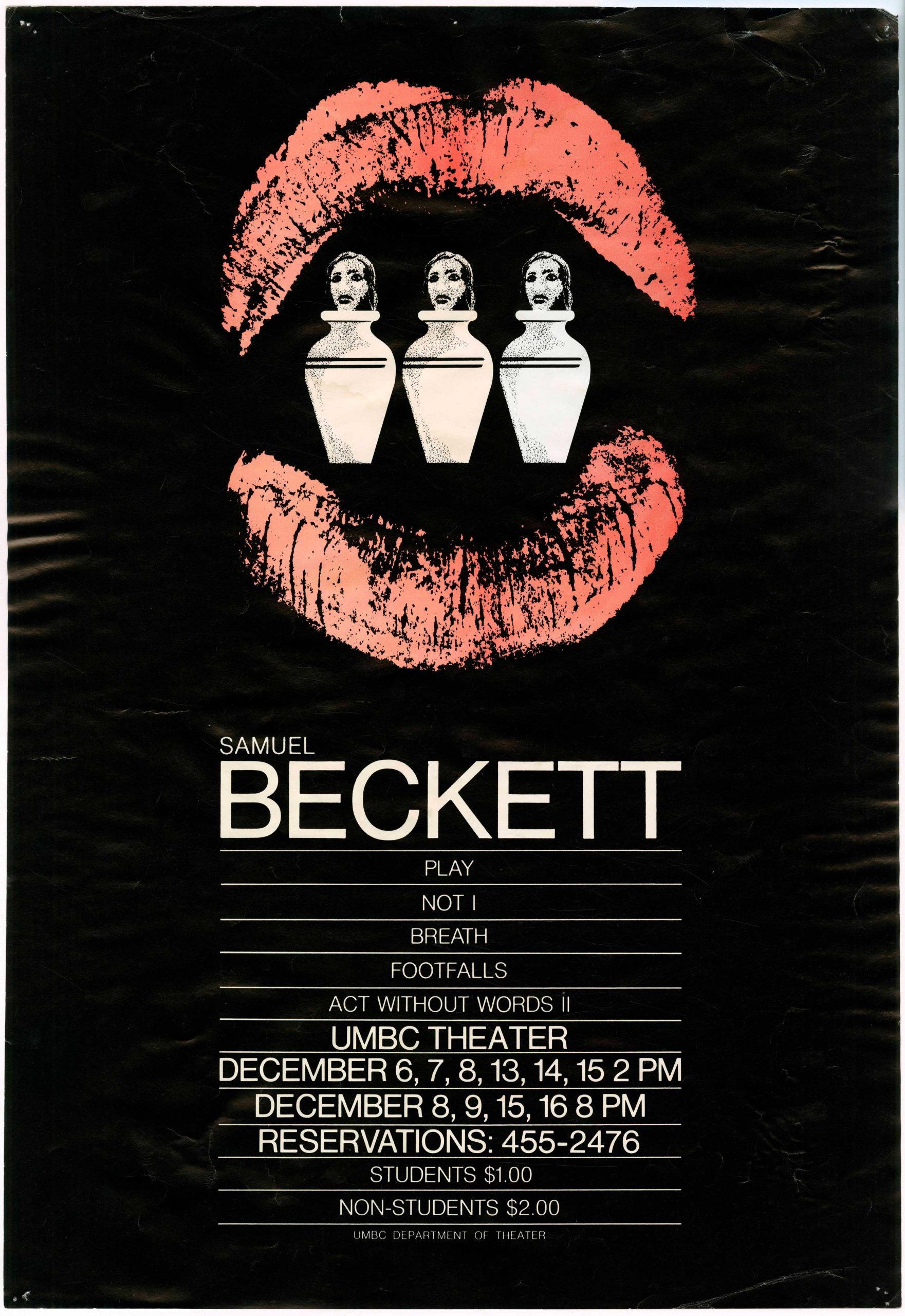
Critics raved about UMBC’s Theatre Department production of five short Samuel Beckett plays produced under the familiar one-word heading Beckett. Maryland Public Television critic Tony Perkins labeled the production “the best college production of 1978,” and Sun writer Earl Arnett said that “the hardworking students at UMBC should be congratulated…Read More

Initially UMBC was a branch campus of College Park, and the curriculum mimicked what was available at the flagship campus. By fall 1967 UMBC’s own academic identity had begun to emerge. A divisional structure was established instead of colleges, including the four Divisions of Humanities, Mathematics, Science, and Social Sciences.…Read More