
The event began with a wine and soft drinks reception (provided by the Libby Kuhn Endowment) on the 7th floor of the Library at 5:00 p.m. followed by Dinner at 6:00 p.m. and then remarks by Xerxes Mehta and discussion.
The play was performed in the UMBC Theatre, a short walk from the Library, at 8 p.m.
Cost was $35 per person, including the theatre ticket.
The UMBC Department of Theatre's description of the performance:
A delicious little tragic farce by Spain’s greatest modern playwright, Don Perlimplín rings sly and shocking changes on that comic staple—the rich old man with the sexy young wife. A small masterpiece from Lorca’s surrealist period, when he was collaborating with his friends Bunuel and Dali, this fantastical parody of the classical Spanish “honor” tragedy plays lighthearted games with color, shape, language, the human form, and “reality” in general. With songs and music.
Set and Costumes: Elena Zlotescu
Lighting: Terry Cobb.
Dinner Choices:
#1: Grilled Tuna Steaks with Tomato Basil Relish
#2: Beef Burgundy Braised Stew with Carrots, Onions & Mushrooms
#3: Risotto with Wild Mushrooms
All entrees were preceded by a spinach salad with egg, cheese & onion, and balsamic vinaigrette dressing. Parsley red bliss potatoes, tempura vegetables and dinner rolls with butter rosettes accompanied each menu choice.
Dessert was All American Chocolate Cake.
The lecture centered on the topics of Dr. Temple's recent book,
Literary Pan-Africanism: History, Contexts, and Criticism.
Dr. Temple's book was the winner of the 2005 Award for Best Scholarly Book at the Cheikh Anta Diop Conference. Through analysis of history and literature, it examines the dynamics of the relationships between African Americans and Africans since the separation of the Middle Passage.
Abstract of the lecture:
Literary Pan-Africanism describes how creative writing serves as a vehicle
for the transmission of ideas about Pan-Africanism, or unity and
cooperation among people of African descent. Some critics suggest that
Africans do not have a psychological need to identify with
African-Americans, however West African literature written since the 1960s
suggests otherwise. In a disscussion of the history of Literary
Pan-Africanism and the role of both imagination and speculation, this talk
features, as a comparative point of departure, the significance of
African American playwright, Lorraine Hansberry's African character
"Asagai" from the reknown 1959 play, A Raisin in the Sun.
Free and open to the public; followed by a reception provided by the Libby Kuhn Memorial Endowment.
1:45 p.m.: Gathering & Refreshments
2:00-3:45: Friends Council meeting
For more information call 410.455.2356 or email aok@umbc.edu.
1:00 Gathering; welcome (Library 767)
Refreshments
Introductions
1:15 Context (from handouts):
UMBC Mission
Library Mission & Goals, Statistics, Planning
Consortia (from web pages: USMAI – Research Port, MDL, BAROC, BALC)
1:30 Walk-through tour of changing Library public service locations:
1. Circulation: self-check, copying & printing
2. Reference: computer workstations; online services from the Reference Desk.
3. Serials & Media: new workstations; new media
1:45 Demonstration of New Services: the Online Library
1. Live Real-Time Online Reference Services
2. Online Selection and Ordering from Anywhere
2:45 Walk-through - Behind the Scenes: tour
1. Gifts and New Book Processing
2. Special Collections: special treatment for rare and valuable resources
3:15 Friends roles in supporting the Library & Gallery:
Discussion in Special Collections
4:00 Closing
Free and open to the public; light refreshments will be provided by the Libby Kuhn Memorial Endowment.
To reserve your place in this seminar and for more information call 410.455.2356 or email aok@umbc.edu.
A discussion and performance of excerpts from music written by Japanese
composers for E. Michael Richards, utilizing his research on extended
clarinet techniques.
Free and open to the public; followed by a reception.
Reception provided by the Libby Kuhn Memorial Endowment.
For more information call 410.455.2356 or email aok@umbc.edu.
The lecture, entitled "A Public Health Catastrophe and How It Came About," was based on his new book,
Plague and Fire: Battling Black Death and the 1900 Burning of Honolulu's Chinatown.
"James Mohr is not just content to tell a compelling story. He connects Honolulu's plague and the fire of 1900 to the great themes of the day: empire, race, power, and fear. I am now convinced that disasters are key historical moments when societies reveal their most fundamental truths. It all comes together here."--Elizabeth Fenn, author of
Pox Americana: The Great Smallpox Epidemic of 1775-82.
"An excellent work of scholarship and a lively read. Professor Mohr has done exhaustive research in primary sources to document his fascinating tale of public health, politics, and racial relations. The book is a significant contribution to the history of medicine and public health and to American history more broadly."-- John Parascandola, author of
The Development of American Pharmacology: John J. Abel and the Shaping of a Discipline.
"Plague and Fire is a riveting account of why, how and with what consequences physician leaders in Hawaii a century ago assumed emergency health powers. Mohr's themes have contemporary resonance, especially his analysis of the effects of scientific uncertainty on policy, competing perceptions of private interests and the common good, and the potential for public health interventions to become vectors for disaster."--Daniel M. Fox, President, Milbank Memorial Fund.
Free and open to the public; followed by a reception.
Co-sponsored by the UMBC History Department.
Reception provided by the Libby Kuhn Memorial Endowment.
For more information call 410.455.2356 or email aok@umbc.edu.
More Information on Dr. Mohr
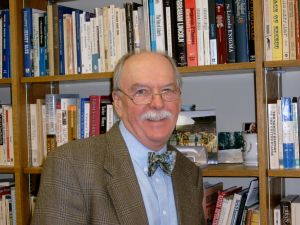
James Mohr
Information
Call 410.455.2356 or email
aok@umbc.edu. Cost was $35 per person, including theatre ticket.
Saturday, December 4, 2004.
The event began with a wine and soft drinks reception on the
7th floor of the Library at 5:00 p.m. followed by Dinner at 6:00 p.m.
and then remarks by Xerxes Mehta and discussion.
The play was performed in the UMBC Theatre, a short walk from the Library, at 8 p.m..
The Department of Theatre's description of the performance:
A fascinating play from one of England's greatest playwrights, David Hare's Fanshen is, in his own words, "a play for Europe, for the West. Besides trying to explain as deftly as possible the aim and operation of land reform in China, to show how it changed souls as well as bodies, the play is much concerned with political leadership, with the relationship in any society between leadership and led."
Brutal, tender, violent, reasoned, and all-absorbing, Fanshen throws a brilliant light on the critical years in the late 1940s that gave birth to modern China by focusing on one village's struggle to survive war, want, oppression and corruption, until it finally learns how to take control of its own destiny.
Set and costumes by guest designer Holly Highfill; lighting by Terry Cobb; vocal director Lynn Watson; dramaturg Susan McCully; directed by Xerxes Mehta.
Violence, nudity, explicit language.
For Mature Audiences.
Dinner Choices:
#1: Chicken Marsala
#2: Seared Tuna Steaks with Mango-Pinapple Salsa
#3: Roasted Vegetable Lasagne
All entrees are preceded by a salad of fresh greens with pears, walnuts and mozzarella cheese dressed with balsamic vinaigrette dressing. Parsley red potatoes, green beans and dinner rolls with butter rosettes will accompany each menu.
Dessert was All American Chocolate Cake.
The idea of healthy lifestyles based on risk factors was the most important innovation in public health and preventive medicine in the twentieth century. Food and pharmaceutical companies have sold hundreds of billions of dollars worth of foods and drugs that claim to produce healthy lifestyles or modify risk factors. This talk will examine the development of the healthy lifestyle theory and the role of commercial and other interests in its application.
Dr. Kars’ research interests are Native American history, women’s history, and early U.S. history.
Her recent book investigates the Regulator Rebellion in pre-Revolutionary North Carolina.
The implications of this event for our understanding of social structure and ideology
at the time of the American Revolution are great.
Co-sponsored by the Center for the Humanities
Free and open to the public.
For more information call 410.455.2356.
Thursday, October 16, 2003.
Convene at 2:45 p.m. in the President's Room, Albin O. Kuhn Library & Gallery, room 768.
Council meeting: 3 p.m.
Open to all members of the Friends of the Library & Gallery.
Followed by two alternative events:
(1) Opening Symposium for Intermedia: The Dick Higgins Collection,
will be held from 4 to 6 pm, featuring Hannah Higgins (University of Illinois at Chicago),
Chris Thompson (Maine College of Art),
Owen Smith (University of Maine), and co-moderators Kathy O’Dell and Lisa Moren.
A reception followed from 6 to 7 pm.
(2) Lecture by David Dunaway, "Oral History in the 21st Century,"
at 4:30 p.m. on the Library 7th floor,
followed by a reception to celebrate the UMBC Oral History Project
and the dedication of the Martha Ross Center for Oral History, 5:30 - 6:30 p.m.
David Dunaway is Associate Professor of English at the University of New Mexico.
He is a national figure in the study of oral history.
He holds a Ph.D. in American Studies from the University of California Berkeley.
He has made a specialty of broadcasting literature and history via radio and televeision documentaries
including "Writing the Southwest," and "Across the Tracks: A Route 66 Story,"
for National Public Radio and Public Radio International.
His talk will explore the history of oral history and the next directions it might take:
automatically transcribed, used in broadcast Internet, and courts,
presented in multimedia in schools and colleges.
He will also highlight ways in which UMBC is serving as a role model
for other institutions of higher learning.
This event was co-sponsored by the
Martha Ross Center for Oral History,
the Center for Hisory Education and
the Department of History.
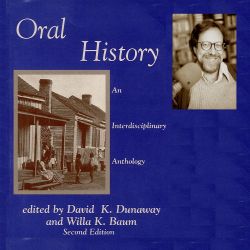
Both of the above events were free and open to the public.
For more information call 410.455.2356.
He is perhaps best known to
the general public for coining the mathematical term
"chaos" with T.Y. Li in a 1975 paper entitled
"Period
Three Implies Chaos". "Chaos" is a mathematical
concept in non-linear dynamics for systems that vary according to precise
deterministic laws but appear to behave in random fashion.
The University's Chaos
Research Group is
one of the best in the world.
The objective of Dr. Yorke's chaos research is to describe those robust properties that
are common in the dynamics of physical, biological, and chemical systems.
Sometimes the phenomena can be described using rigorous mathematics, and
sometimes only phenomenological descriptions can be obtained from intensive
numerical studies. Most often, the research is a blend of numerical and
rigorous techniques.
For more information call 410.455.2356.
Free and open to the public.
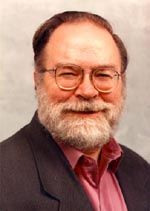
James Yorke
This free event was followed by a reception and was open to the public.
It was preceded by a meeting of the Friends of the Library & Gallery Council at 2 p.m.
in the Library, room 768.
Mention a name from a beloved childhood picture book---Madeline,
Corduroy, Peter Rabbit, Max and his "wild things"---and most adults can
recollect a bright image, fragments of a story, the timbre of a certain
reading voice, the sensation of being held, and best of all being together
with someone and enveloped in fantasy. Why do picture book images shown to us
as young children linger in our minds? How do picture books shape our lives
early on and even later into adulthood? How can we better understand the
profound impact of reading to children? This lecture explored these
questions and illustrated ways in which classic picture books transmit
psychological wisdom, convey moral lessons, shape tastes, foster imagination,
and also implant subtle prejudices.
Ellen Handler Spitz is a Professor in the Honors College as well as
in the Department of Visual Arts. She was educated at Barnard College
and at Harvard and Columbia Universities; in addition, she studied
at the Art Students League in New York, at the School of the Museum of
Fine Arts in Boston, and at SUNY, Purchase, under Antonio Frasconi.
She has held year-long fellowships at the Getty Center for the History of Art
and the Humanities in Santa Monica, the Radcliffe Institute at Harvard University
(formerly, the Bunting Institute), and at the Center for Advanced Study,
Stanford University. She has taught and/or lectured in England, France,
Italy, Israel, the Netherlands, Austria, Spain, Russia, Canada, and the
Peoples Republic of China. She is the author of Art and Psyche (Yale, 1985),
Image and Insight (Columbia, 1991), Museums of the Mind (Yale, 1994), and
Inside Picture Books (Yale, 1999). With several colleagues, she co-edited
Freud and Forbidden Knowledge (1994) and Bertolucci's Last Emperor (1998),
and she has published numerous articles, chapters, and reviews. At UMBC,
she teaches interdisciplinary seminars that involve philosophy, psychology,
literature, and the performing arts as well as visual culture.
In her talk, entitled “Cosmopolitan Tendencies,” Dr. Berman discussed the
connection between modernism and cosmopolitanism and its legacy for thinking
about global identities today. Modernist writers of the early decades of the
twentieth century are often understood to present a simplistic version of
cosmopolitan identity, abandoning local community for connection to the “world
at large” or to an idealized International Style. It is against this monolithic
internationalism that many recent critics of modernism have rebelled.
Berman has argued in her book that many modernist texts create subtly
nuanced versions of cosmopolitanism that remain deeply bound to the value of
community. Her talk examined the implications of this new cosmopolitanism
for reading literary modernism and for our re-working of cosmopolitan identities
in the twenty-first century.
The Department of Theatre
presents An Evening of Adultery, two
one-act plays by George
Bernard Shaw: Overruled and
Passion, Poison and Petrifaction,
on the ironies of infidelity, directed by Colette Searls. Bored by
countless treatments of adultery on the European stage, Bernard Shaw
offered Overruled as his own "demonstration." What might
happen if two married couples, caught red-handed, try to duke it out in a
proper honest chat? From the opposite side of the Shawian brain, we
present Passion, Poison & Petrifaction as its wayward
companion. A parody of tragic melodrama, this "tomfoolery"
unleashes the romance of love and vengeance with no such civilized
restraint. The production features the work of Elena Zlotescu as costume
& scenic designer, Terry Cobb as lighting and sound designer, Lynn
Watson as vocal and dialect coach, and Greggory Schraven and technical
director.
(Even More Previous - 2001) Dinner Theater: The Good Woman of Setzuan, a play by Bertholt Brecht.
Barbara Stowasser